RoamCouch: The Poetry of Stencil

Layer by layer, Japanese artist RoamCouch transforms the precision of stencil into images filled with memory, light and quiet emotion.

Behind the name RoamCouch is Ryo Ogawa, a Japanese artist whose work has pushed stencil far beyond its associations with repetition and immediacy. His images are intricate, atmospheric and often cinematic: cities glow at night, figures appear beneath vast skies, and flashes of colour interrupt otherwise monochrome landscapes.

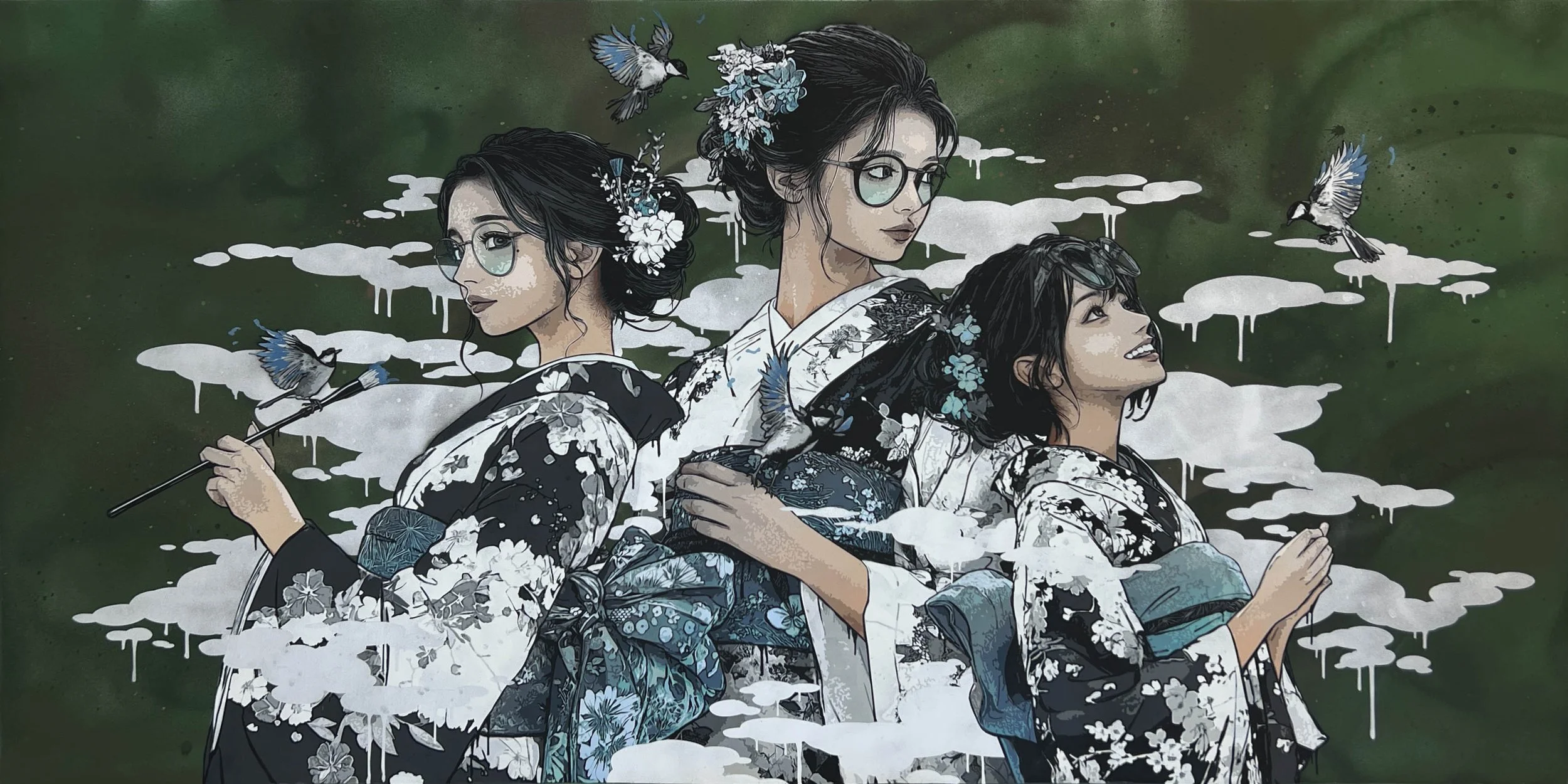
At the heart of this visual language is an exceptionally meticulous process. Some of RoamCouch's works are built from more than fifty layers of hand-cut stencils, each adding another element of depth, shadow or detail. The technique is demanding, but precision is never the final purpose. What matters is the atmosphere that emerges from it.
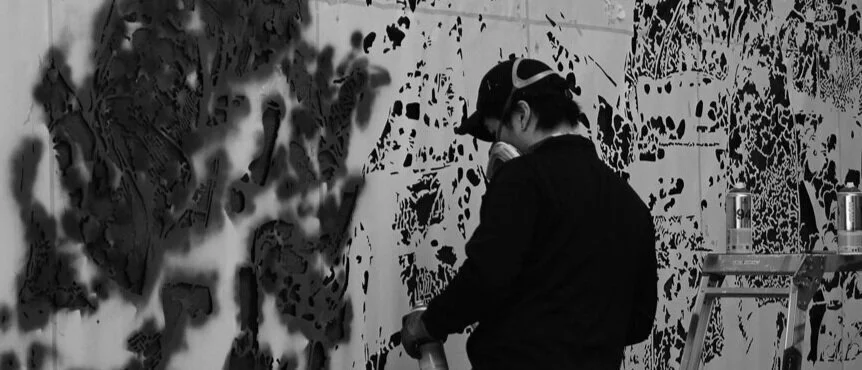
Japanese artist RoamCouch working on a large-scale stencil artwork

Between Precision and Emotion

Before becoming a full-time artist, Ogawa worked as a designer. After a serious illness led him to reconsider the direction of his life, he began his transition into art and adopted the name RoamCouch in 2011. His background in design remains visible in the careful construction of his compositions, but his works are driven just as much by emotion and storytelling.

Recurring cityscapes become stages for intimate moments. Children run through streets, couples meet beneath stars, bridges stretch towards distant skylines. Familiar places such as Paris, London or New York are transformed into something closer to memory than documentation.

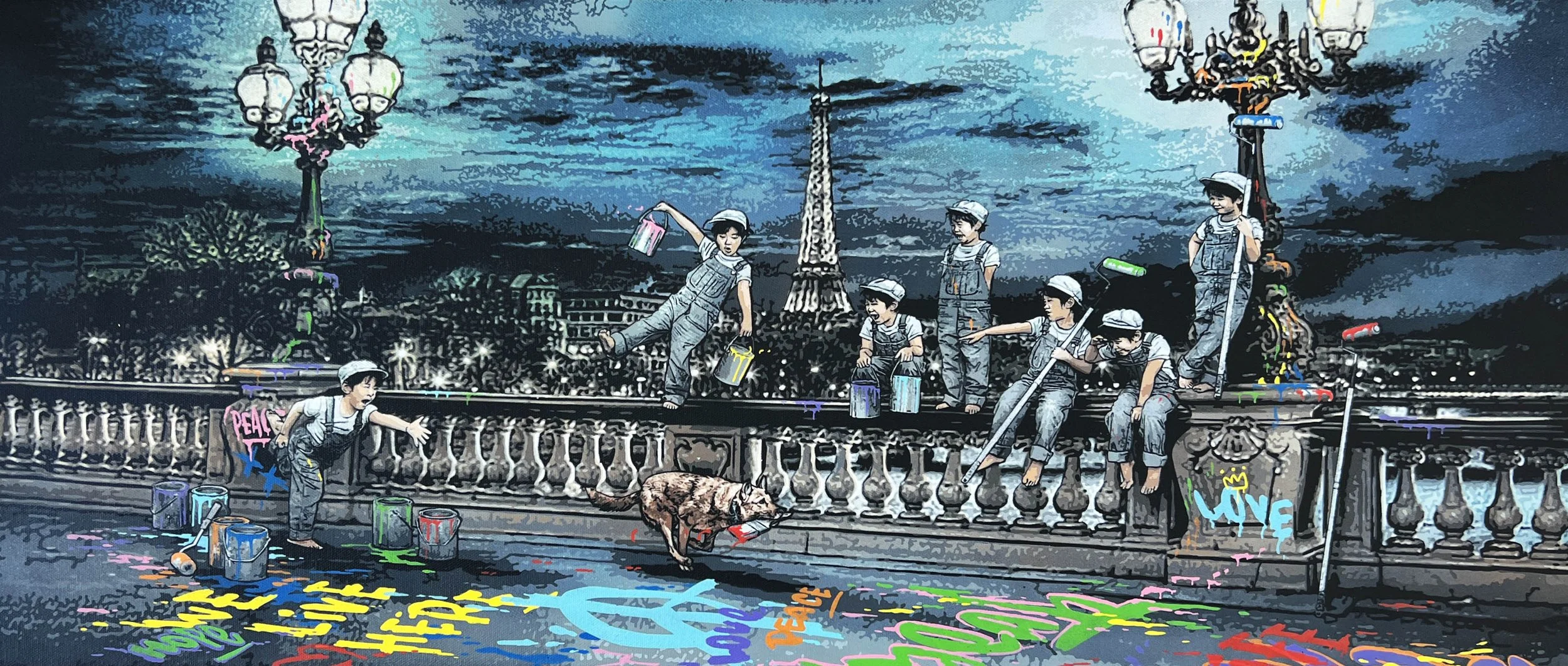
Colour often plays a decisive role. Against detailed monochrome backgrounds, sudden bands of rainbow colour, scattered light or painted interventions introduce movement and imagination. In works such as Rainbow Inc. Paris, the contrast transforms a recognisable view of the Eiffel Tower and the Seine into a scene suspended somewhere between reality and dream.
A Contemporary Dialogue with Japan

RoamCouch's practice also remains closely connected to Japanese visual culture. He describes part of his work as “Neo Ukiyo-e,” combining contemporary stencil techniques with Mino washi, the traditional Japanese paper associated with his home region of Gifu. Rather than reproducing ukiyo-e, he brings its visual heritage into conversation with contemporary imagery and street art.

That relationship with place extends beyond the studio. In 2014, RoamCouch launched the Emotional Bridge Project in Gifu, creating murals as a way of bringing art into the community and attracting visitors to his hometown. His international practice and his local roots have continued to develop alongside one another.
From Gifu to Paris

RoamCouch's relationship with NextStreet Gallery has unfolded over several years. His 2022 solo exhibition, Seeking the Stars, introduced Paris audiences to his dreamlike cityscapes and layered stencil technique. In September 2025, he returned to the gallery with Stencil Poet: Whispers of the Seasons, a solo exhibition that further explored the poetic and emotional dimensions of his practice.

Across these different bodies of work, one tension remains constant: extraordinary technical control alongside a sense of tenderness and escape. RoamCouch may construct his images one stencil at a time, but the finished works are less about technique than what remains after it: a place, a memory, a fleeting moment imagined again.
Sébastien Bayet: Inside the Artist’s Studio

In Sébastien Bayet's paintings, the studio is more than a setting. It is a portrait of the artist, told through objects, materials and the traces of making.

For Sébastien Bayet, the artist's studio is a subject in its own right. Works in progress, scattered objects, fragments of colour, the quiet disorder of creation: these are the things that reveal an artist's world.

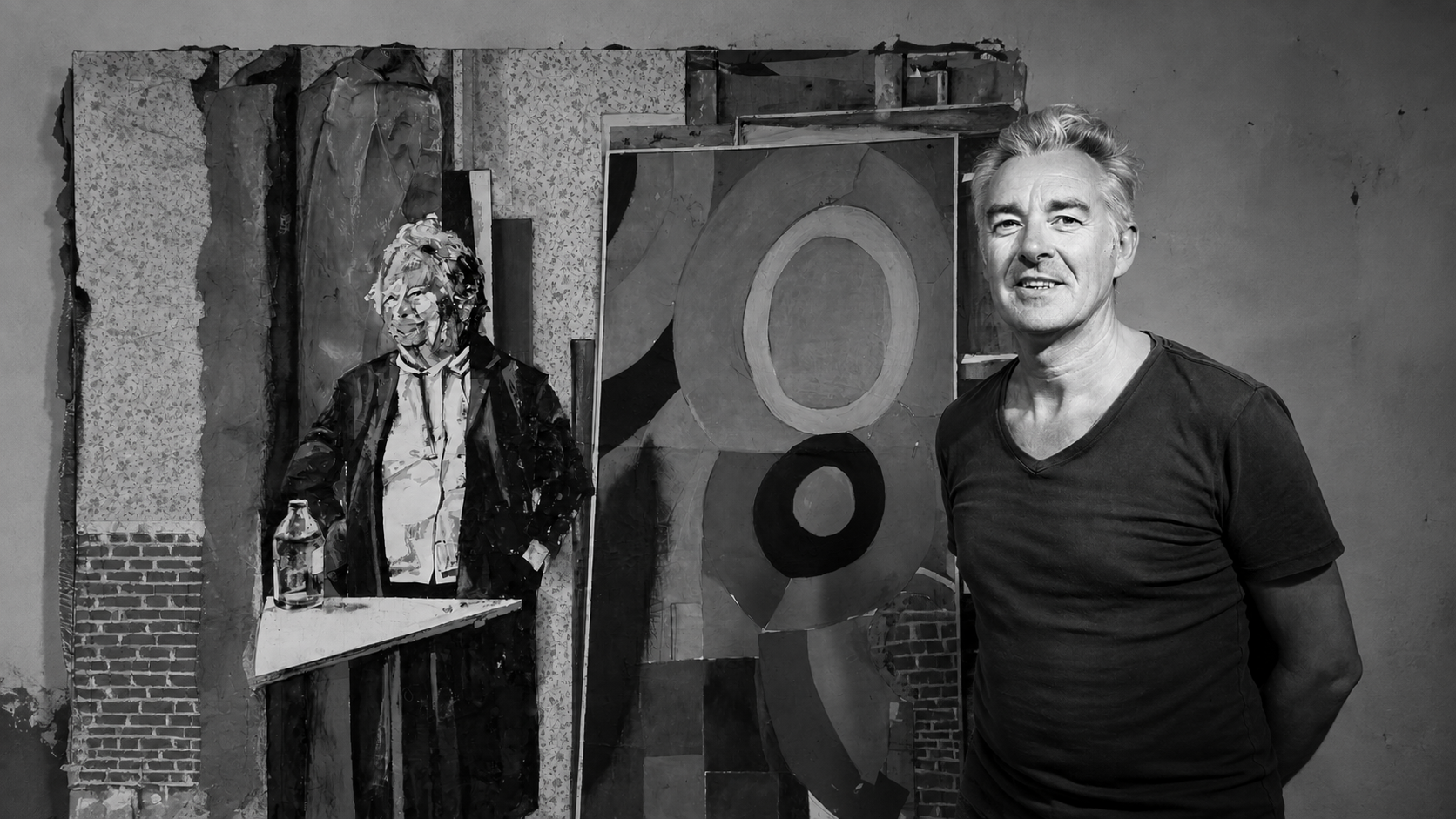
Sébastien Bayet in his studio with his artworks

In his recent series, Bayet revisits the studios of figures such as Sonia Delaunay, Frida Kahlo, Hilma af Klint, Nicolas de Staël, Tracey Emin and Rose Wylie. He does not reconstruct these interiors with documentary precision. Instead, he reimagines them in his own visual language, so that each studio becomes a portrait without relying on a face: a presence felt through the space someone inhabits and the work around them.

Material carries this idea further. Bayet moves between painting, collage and relief, combining oil paint with textiles, worn fabrics and found materials. Since 2017, his practice has included discarded sailcloth once used by Vezo fishermen in Madagascar, where he spends part of his time. Marked by use, weather and age, these fabrics arrive on the canvas with a history already embedded in their surfaces.

Sébastien Bayet artwork with close-up details of layered paint and textile collage

The result is a body of work that is felt as much as seen. Fabrics overlap, edges stay visible, and painted passages meet surfaces already altered by time. The image is built in layers, and so is its sense of memory.

In works such as Après l'atelier – Sonia Delaunay, portraiture, geometric forms and textile fragments share a single composition. The studio becomes both a real place and an imagined one, where Bayet's own materials meet the artistic histories he chooses to revisit.

At NextStreet Gallery, these works reward a slower look. Seams, frayed edges and traces of wear are part of how the paintings are read, revealing details that only come into focus up close.

For Bayet, the studio is ultimately a place of traces: of gestures, objects, influences and time. Material becomes memory made visible.

A New Space at NextStreet Gallery

This autumn, NextStreet Gallery opens a new chapter at Place des Vosges with the expansion of its exhibition space.

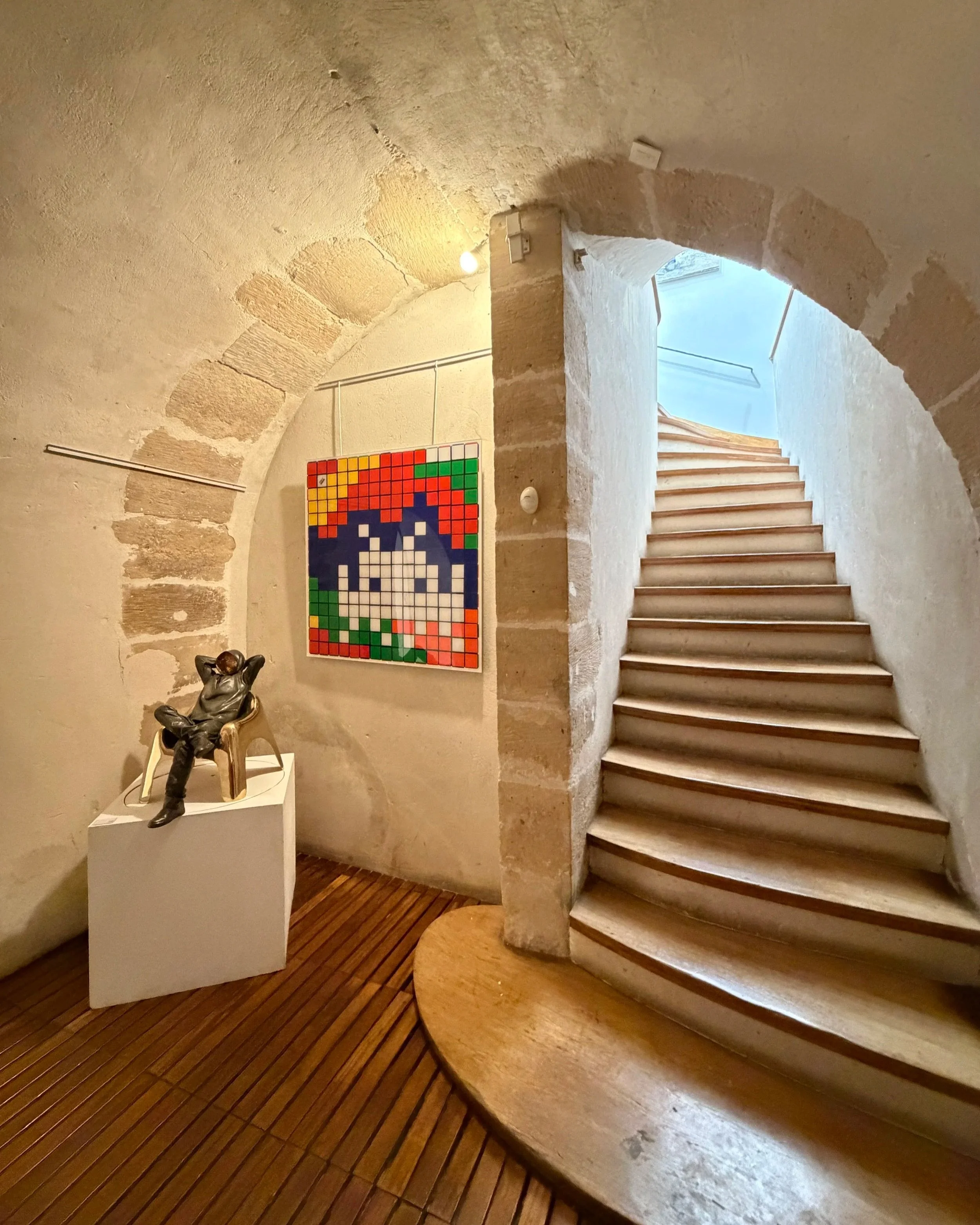
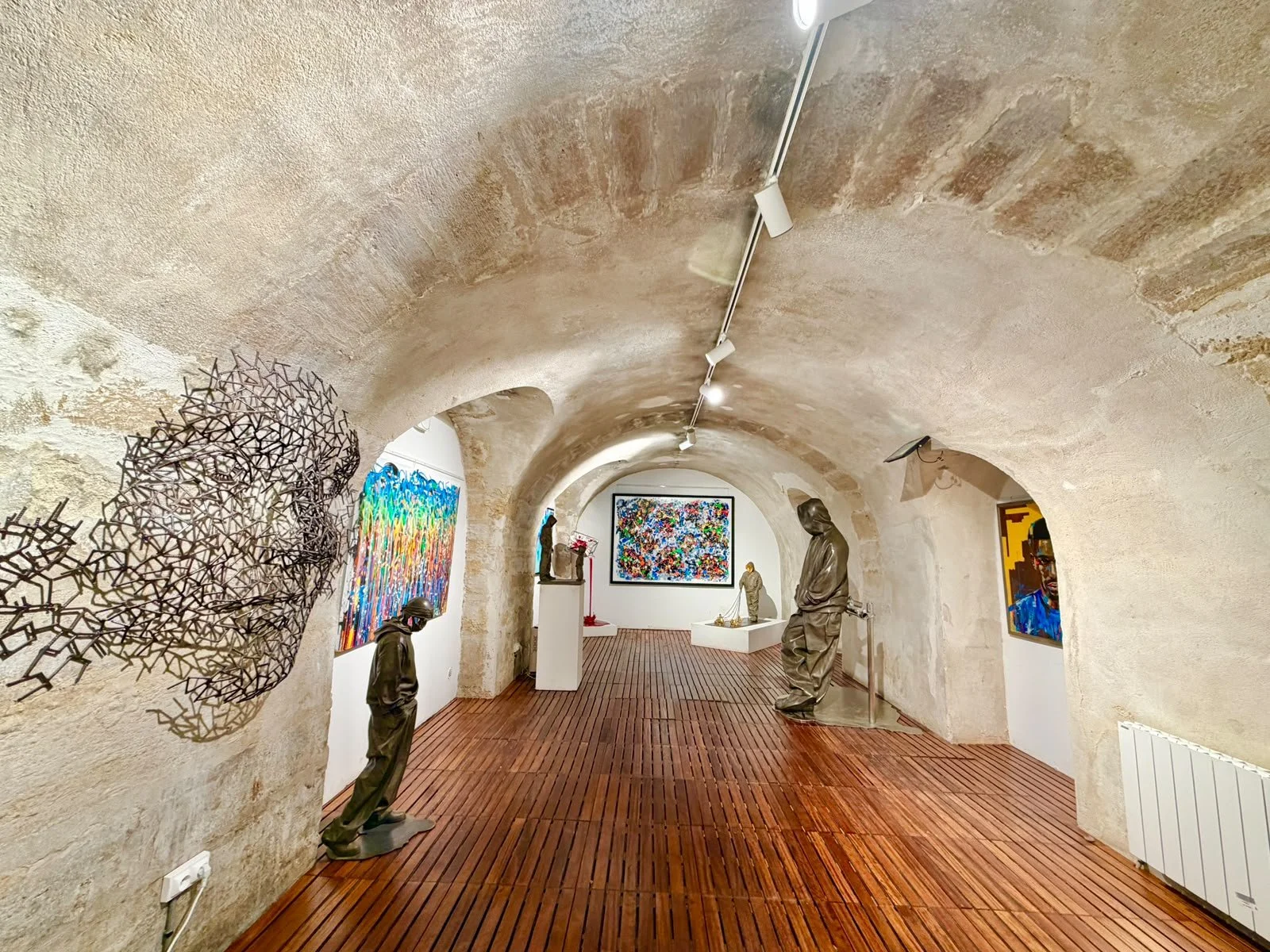
Beneath the gallery, a new room has been taking shape. Now open to the public, the lower level doubles our exhibition space and opens up new possibilities for the way we present and experience art.

The room feels unmistakably Parisian. A low vaulted ceiling, softly textured by time, curves over bright white walls, while a warm timber floor brings a sense of intimacy. Quiet and slightly unexpected, it invites visitors to slow down and look more closely.

That atmosphere also changes the way works inhabit the gallery. Large-scale paintings have room to breathe, while sculptures can stand independently, creating new dialogues between works throughout the space.

For NextStreet Gallery, the new level means more than additional square metres. It gives us the freedom to present larger selections of works, build more ambitious installations, and allow an exhibition to unfold across two floors rather than one.

We see the lower level as a place for experimentation: for series that need room to develop, for works that reward close attention, and for exhibitions where the experience of the space becomes part of the encounter with the art.

We look forward to welcoming you.

Alexis Raoult: The Art of the Animal Portrait

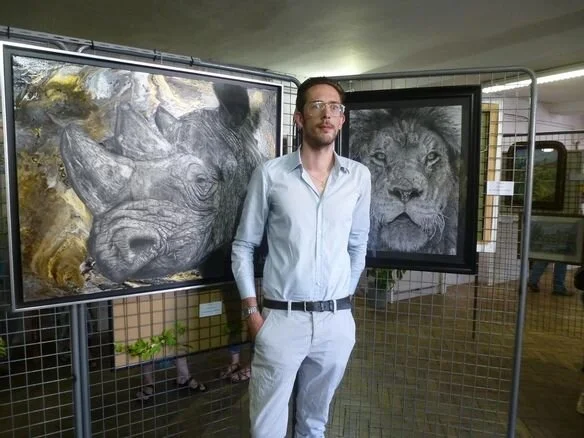
Through remarkably detailed black-and-white drawings, French artist Alexis Raoult captures the presence, sensitivity and individuality of the animal world.

Drawing has been a constant in Alexis Raoult's life. Born in the Paris region in 1993, he followed an unconventional path before dedicating himself fully to art. As a teenager, he studied electrical work while continuing to fill notebooks with drawings. At 18, he moved to Brittany, where he took on various jobs while continuing to sketch.

In 2012, drawing became the centre of his practice, a process he describes as a "sequence of emotions." After experimenting with portraits and painting, he gradually returned to drawing as the medium through which he could pursue an increasingly precise form of realism.

Capturing the Animal Gaze

Since 2017, animals have become central to Raoult's work. His monochrome portraits focus not simply on anatomical precision, but on expression. Through the gaze, posture and smallest details of his subjects, he seeks to convey the sensitivity and intelligence of wild animals.

Working primarily in black and white, Raoult builds his images through meticulous drawing, creating an intensity that gives his subjects an almost physical presence. Rather than treating the animal as an object of observation, his portraits invite the viewer into a direct encounter.

From Photography to Drawing

A decisive moment came through his encounter with photographer Lambert Davis. One of Davis's photographs, depicting a monkey with an especially intense gaze, inspired Raoult to translate the image into drawing. Their collaboration continued, and Raoult subsequently worked from photographs by other photographers.

Since 2020, however, another element has entered his process: Raoult has increasingly begun working from his own photographs, giving him greater control over the encounter that precedes the drawing itself.

Photography and drawing therefore become successive stages of the same observation: first meeting the subject through the lens, then returning to it slowly through the act of drawing.

SAKE STC: Atlas at Danone's Convergence Headquarters

For Danone's Convergence headquarters in Rueil-Malmaison, SAKE STC brought urban art into the heart of the architectural project with a monumental three-metre sculpture.

In 2021, NextStreet Gallery collaborated with French artist SAKE STC on an artistic project for Convergence, Danone's headquarters in Rueil-Malmaison, just outside Paris.

At the centre of the project stands Atlas, a three-metre-high sculpture created in resin, fiberglass and stainless steel. Installed in the building's central outdoor space, the work brings SAKE STC's distinctive visual language into dialogue with the contemporary architecture surrounding it.

Atlas is part of the artist's Statue Art Crime project, in which references to classical sculpture meet the codes and energy of graffiti and urban art. By bringing these different visual traditions together, SAKE STC transforms the monumental language of classical statuary through a contemporary street-art perspective.

Art at the Heart of Convergence

Designed by ORY.architecture, Convergence was completed in 2020 after more than two years of construction. The complex extends across approximately 25,000 square metres and was conceived around an open, landscaped central patio. At the time of its completion, it was presented as Danone's largest headquarters worldwide.

Art formed part of the project from the outset. Alongside Atlas, the development also incorporated interventions by local graffiti artists, bringing contemporary artistic practices into the everyday environment of the workplace.

For NextStreet Gallery, the project reflects a broader dialogue between urban art, sculpture and architecture, taking SAKE STC's work beyond the traditional exhibition space and placing it directly within a large-scale architectural setting.

Joshua Jensen-Nagle Featured in Home Immo Paris Magazine

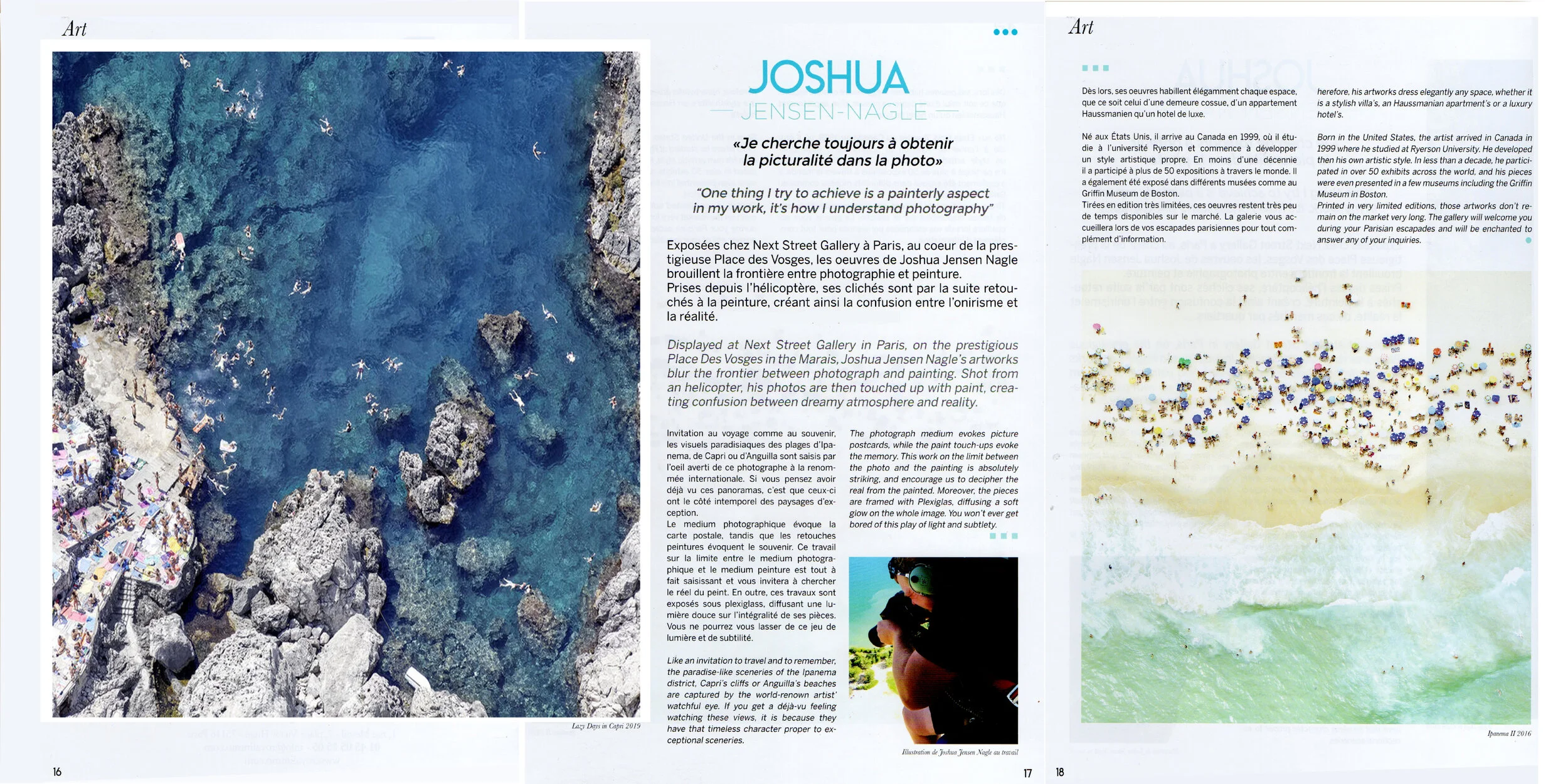
Joshua Jensen-Nagle's dreamlike photography and distinctive approach to image-making were featured in the April 2020 issue of Home Immo Paris Magazine.

In April 2020, NextStreet Gallery collaborated with Home Immo Paris Magazine on a feature dedicated to photographer Joshua Jensen-Nagle.

The article explores the artist's inspirations, his approach to photography and the experimental techniques behind his distinctive visual language. Known for his dreamlike large-scale images, Jensen-Nagle approaches photography as a means of capturing a feeling rather than simply documenting reality. His practice has evolved through experiments with Polaroid film, painting and rephotography, creating images that often sit somewhere between photography and painting.

Read the original feature below.

Joshua Jensen-Nagle in Home Immo Paris Magazine

Summer Collection

An exciting new summer collection featuring works by Stikki Peaches, Guy Boudro and Joshua Jensen-Nagle.

Canadian artist Stikki Peaches is renowned for his works combining acrylic paint, collage and silkscreen techniques. His distinctive visual language brings together pop-culture references and the influence of lowbrow and street art.

For more than 25 years, Guy Boudro's visual language has attracted art collectors. Warhol, Haring, Lichtenstein and Rosenquist have been significant influences on the artist. His distinctive style combines his Pop Art roots with a Surrealist spirit.

Joshua Jensen-Nagle is an established artist who has exhibited internationally in museums and galleries. His work combines photography and painting through a distinctive mixed-media approach.

New work of Kate Moss by Stikki Peaches

New work of Kate Moss by Stikki Peaches

New work by Guy Boudro

New work by Guy Bourdo

New work by Joshua Jensen-Nagle

New work by Joshua Jensen-Nagle

Village Royal by Pimax

Event Details

NextStreet Gallery presents the luxurious Village Royal by Pimax. The show is on display from July 13 to September 14, 2019, at 25 rue Royale, Paris, France. The exhibition features works such as Tomato Splash, Spray Can, Love, Nourf, and more!

About Pimax

Pimax creates ephemeral murals and stencil posters. His inspirations range from Andy Warhol's Marilyn Monroe and the Velvet Underground's banana to the Japanese character Goldorak. Here in Paris, in the Marais district, Pimax twists fashion with a colourful touch of popular culture. This blend is a recurring theme throughout his artistic practice. He often collaborates with fellow street artists, Nature’s Revenge, Nemo or Jef Aérosol.

Village Royal

“Discover this prestigious and elegant location, where the spirit of the Musketeers still pervades above luxury retailers. Whether indulging in shopping or taking a delicious moment of relaxation, head for 25 rue Royale in the eighth arrondissement of Paris at the core of the prestigious golden triangle, between la Madeleine and the rue du Faubourg Saint Honoré,” (villageroyal.com).

“Giant Nourf” by Pimax, on display at Village Royal.

“Giant Nourf” by Pimax, on display at Village Royal.

“Giant Love” by Pimax, on View at Village Royal

“Giant Love” by Pimax, on View at Village Royal

“Giant Spray Can” by Pimax, on display at Village Royal

“Giant Spray Can” by Pimax, on display at Village Royal

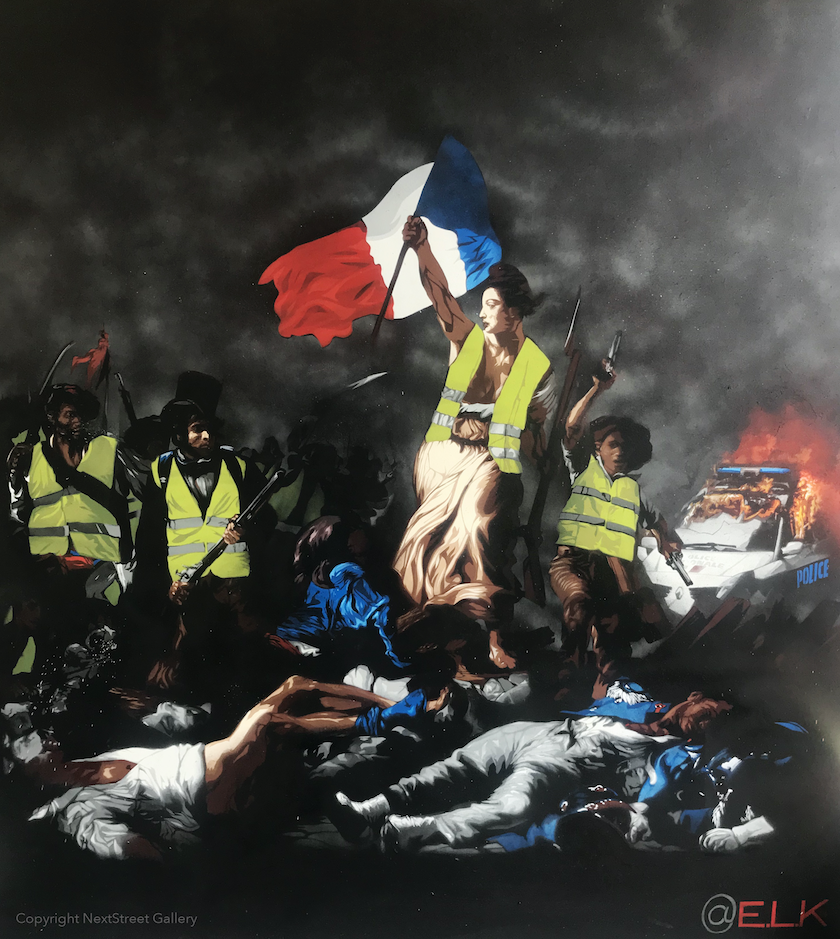
MURAL WORK " GILET JAUNE" BY LUKE CORNISH AKA ELK

The Right to Riot

 Renowned Australian artist Luke Cornish, who works under the alias ELK, joined NextStreet Art Gallery last night for a live demonstration of his mural work. Before the performance, we had the opportunity to sit down with him to better understand the intention behind his work. His piece, based on Delacroix’s La Liberté Guidant le Peuple (1830), captures his perception of the modern “French spirit”, particularly with reference to the Gilet Jaune movement. What started as a grassroots citizens protest against the fuel tax, has escalated to a wider anti-government sentiment.  As an outsider, ELK attempts to document what makes this movement pertinent on a global scale, and what it means to have the right to riot.

Screen Shot 2019-04-09 at 13.47.59.png

1789 remains one of the most politically, socially and artistically influential dates in the history of France. The tumultuous six years that followed the storming of the Bastille, involved a violent dismantling of the monarchy. The timeline of events that occurred during this period is eerily similar to the protests taking place in modern day Paris, albeit disguised with modern apparel and weaponry. The formulaic tradition of protesting see\ms to be a part of French culture; everyday citizens rising up to fight for better living conditions. However, the development of technology has enabled the acceleration of this trend throughout time. In our current global climate, the need for change is an epidemic reaching further than the streets of Paris. This is the quest for liberty that ELK is trying to capture with his work.


Cornish, originally from Canberra and working predominantly out of Sydney, takes his love for street art around the world. He has travelled to countries such as Syria and Lebanon to work with those faced with the crisis of liberty on a daily basis. Having experienced it himself, ELK was inspired to create a series about the human plight. He often says that being an artist is akin to being an investigator: someone who sheds light on what plagues society, and documents it in order to change the status quo. Upon arriving to Paris and witnessing the Gilet Jaune uprisings, ELK found similarities with other experiences around the world. He concluded that the notion of society’s inability to put up with injustice, is a cyclical entity.


His artwork utilizes classical imagery as a vehicle to parallel modern phenomena with the age-old struggle for justice. When comparing La Liberté Guidant Le Peuple to Cornish’s mural work, we see an evolved France; a diverse selection of protagonists representing todays bourgeois population. The bright yellow vests serve to highlight the desire for equal platform and opportunity. As he works, Tourists and Parisians pause outside NextStreet to ponder the implications of the piece. When something so violent and pertinent is placed on a canvas- it becomes a struggle of the mind more than one of the streets for a brief time. This is a fascinating dynamic that ELK works to uncover.


IMG_5564.jpg

When asked about his process, Cornish starts by clarifying that his job, as an artist, is to hold a mirror up to society. This is a solitary position to be in, but necessary by nature. It is one that requires patience, an open mind and somewhat of an obsessive need to understand and document. The result of this is evidently reflected in his thought-provoking work, that we are proud to host at NextStreet gallery. We are curious to see how the mural might start a further dialogue around what it means to have the right to riot, on a global scale.


FEATURE: URBAN ART SHOW

NextStreet Gallery is proud to present an art show that captures an integral part of our modern moment: Urban Show. Opening on March 21, and running until April 6, this group exhibition highlights the work of 5 artists from around the world- working on shaping our global perception of street art. None of the artists shy away from bringing their personal contexts to the work. 

The variation of mediums and styles demonstrate an evolving definition of urbanity. Each artist focuses on the intersection of their subcultures; whether it be through the hip hop world, LGBTQ community or other cultural minorities. Our exhibition creates a global framework allowing urban art lovers to have a broader vision of the scope of street art. 

Each artist focuses on different approaches we can take as a community to move forward. Kurar, for example, tackles the socio-political challenges of this moment by evaluating our origins as a society. His theory is that we might be able to resolve injustice through awareness. This is beautifully in dialogue with Nuno Viegas, who suggests that perhaps the solution to the rapid acceleration of society is focusing on the simple, but powerful. He exquisitely balances the modern and classic world through focusing on the essential through-lines that have existed throughout history. 

By contrast, Drew Merritt focuses on evoking change through the emotional reaction of the onlooker- a complex experience that is justly represented in his extremely detailed work. Aaron Li-Hill, on a similar vein, is fascinated by information saturation and the future of industrialisation through creating large scale mural work. Vera Kochubey investigates the psychology of industry and our growing world. These different perspectives not only compliment, but also build off of each other. The points of intersection between the five artists creates a show that functions as an active dialogue.

We are excited to welcome the audience into our space to continue this discussion about the future of culture through the lens of street art.

FEATURE: AARON LI-HILL

Aaron Li-Hill is Canadian artist who is currently based out of Brooklyn. His incredibly diverse upbringing reflects his career. He has Australian, Polish, Canadian and Chinese origins, and was brought up in both downtown Toronto and California. His works vary dramatically by scale, medium and subject, which makes him a notable emerging artist in the world of street art. While pursuing a Bachelor of fine Arts from OCAD; one of the most comprehensive art, design and media universities in Canada, he found a passion for mural work and Graffiti. He has collaborated on international shows in Australia, Thailand, Mexico and China. 

“Suspended”

“Suspended”

One of the most fascinating parts of Li-Hill’s work are his multi-faceted subjects who guide the audience’s eye towards something greater and external. The dynamic movement creates episodic scenes that are similar to a sequence of successively shot photographs, or a flip book. The result is the illusion of a single subject entangled in paradoxes that are both self-imposed and conditional. 

 His greatest inspiration has been the conflict between the individual and society. This evolving world demands constant reinvention of one’s self and environment. This has become a necessity of survival, but is growing at such a fast pace in a consumerist driven society, that the internal and external balances of the world are constantly being disrupted. This leaves us in a constant scramble to keep up- a sense that is clearly evoked in Li-Hill’s artwork. 

 His formal training in graphic design, illustration, painting and sculpture, as well has his informal fascination with literature, travel and film has shaped his artistic manifesto. He works with walls, multi-layered recycled materials as well as conventional canvases. Through the manipulation of light and medium, he able to create distinctive pieces. NextStreet gallery is honored to have a working relationship with Li-Hill, and is proud to present several of his pieces which are currently on display. 


For price inquiries, please email contact@nextstreetgallery.com

Interview : Nuno Viegas, bercé par le graffiti

1- Quels sont les thèmes ou les artistes qui t’inspirent, te passionnent ? What themes or artists inspire you ?

En tant que thème, le graffiti est visiblement mon point de mire et ma plus grande source d'inspiration. En ce qui concerne les artistes, beaucoup de créateurs différents m'inspirent, comme pour les artistes graffitis de la oldschool comme Seen et les plus récents crews comme 1UP. Mais des photographes comme Philip Halsman et Asger Carlsen ou l'artiste performance Francis Alys m'inspirent également. Il y a beaucoup d'artistes issu de différents domaines qui m'inspirent d'une façon ou d'une autre, cela nécessiterait une longue liste de tous les nommer. Pour l'art contemporain urbain, j'adore également beaucoup d'artistes mais je garde un oeil attentif sur le travail de Telmo Miel et Fanakapan. 

As a theme graffiti is noticeably my focus point and biggest inspiration. When it comes to artists there a lot of different creators who inspire me from oldschool graffiti writers like Seen to the more recent crews like 1UP. But it goes all the way from photographers like Philip Halsman to Asger Carlsen or the performative artist Francis Alys. There are a lot of artists from all different areas who somehow inspire me. it would take a long list to name them all. When it comes to urban contemporary art I also look up to a lot of artists but I keep a close look to Telmo Miel and Fanakapan’s work.

13063116_713165575491974_2992806247452489859_o.jpg

2- Quelle ville t’attire particulièrement pour son ambiance créative ? Which city attracts you particularly for its creative atmosphere ?

Rotterdam! C'était la première ville où j'ai remarqué que beaucoup de gens gagnaient leur vie grâce à leur propre créativité. Cela m'a amené à croire que ceci serait possible pour moi et a déclenché ma volonté d'être un artiste à temps plein. 

Rotterdam! It was the first city I noticed a lot of people making a living out of their own creativity which lead me to believe that this would be possible for me and triggered my will to be a full time artist.

photo-1526505917130-857817501277.jpg

3- Quel est le plus gros challenge auquel tu fus confronté dans ta carrière ? What is the biggest challenge you faced during your career ?

Seuls les défis techniques dans mes productions. Comme par exemple, réaliser des fondus très lisse avec de la peinture acrylic sur toile en utilisant des pinceaux. Je travaille toujours sur ce challenge.

Only tecnhical challenges in my productions. Like achieving very smooth fades with acrylic paintings on canvas using brushes. Still working on this challenge.

4- Quels sont tes projets dans les mois à venir ? What are your projects for the coming months ?

Un solo show en collaboration avec Fanakapan à Londres. "Live at the Museum" à l'Urban Nation de Berlin. Pow Wow à Rotterdam. Et j'espère, l'Art Basel à Miami.

A featuring in the solo show by Fanakapan in London. “Live at the Museum” at Urban Nation Berlin. Pow Wow at Rotterdam. Hopefully Art Basel Miami.

5- Si vous étiez un film, ce serait … If you were a film, it would be…

Difficile à dire... Peut-être "Les Seigneurs de Dogtown" pourrait être un bon parallèle d'une façon. C'est le film qui me vient à l'esprit pour le moment. 

Hard to say... Maybe “Lords of Dogtown” would work as a good parallel in a way. That is what comes to my mind at the moment.

lords-of-dogtown.jpg

6- Si vous étiez une marque, ce serait… If you were a brand, it would be….

Tesla

7- Si vous étiez un musée, ce serait…. If you were a museum, it would be...

Urban Nation Berlin


"De Pôle en Pôle : un Monde qui Disparait", les magnifiques et alarmantes photos de Sebastian Copeland s'exposent à NextStreet Gallery

Le célèbre photographe et explorateur polaire Sebastian Copeland a préparé pour la rentrée de 2018 une exposition exceptionnelle, “De Pôle en Pôle : Un Monde qui disparait” qui réunit des clichés emblématiques de ses explorations polaires. La NextSreet Gallery aura l’honneur d’héberger l’exposition, à partir d’Octobre 2018 !


Né le 3 avril 1964 à Paris, de nationalité franco-britannico-américaine, Sebastian Copeland a été élu en 2017 l’un des 25 plus grands aventuriers de ces 25 dernières années par le magazine Men’s Journal. Après plus de vingt années d’expéditions dans les zones Arctique, Antarctique et au Groenland, il présente aujourd’hui la plus grande rétrospective photographique de sa carrière et la première en France.  

SebastianCopeland

L’exposition est un cri d’alerte urgent lancé à l’humanité contre le changement climatique. Avec ses clichés d’iceberg à couper le souffle, Copeland nous offre autant un voyage esthétique, qu’un plaidoyer en faveur de la cause environnementale, comme il le souligne :

"La beauté est ce qui fait le lien entre le coeur et l'esprit. Elle donne au coeur les arguments pour convaincre l'esprit de s'investir et s'engager." 

Ce voyage à travers les pôles est un appel à l’attention du grand public à réagir. Car même si ces contrées nous paraissent éloignées, elles n’en sont pas moins épargnées par la dégradation du globe. On peut y lire notre avenir, ajoute Copeland en évoquant la hausse des températures et la raréfication des ressources.

Copeland

L’exposition, qui est programmée pour une durée de 4 mois, s’est ouverte au mois de Septembre à la plus prestige galerie de plein air au monde : au Sénat, sur les grilles du Jardin du Luxembourg. La NextStreet Gallery aura la joie d’ouvrir une exposition complémentaire à celle du Sénat, au mois d’Octobre, dans l’espoir d’inspirer de nouveaux défenseurs de la nature!

Exposition du 13 Octobre au 28 Octobre 2018
Vernissage le Samedi 13 Octobre, à partir de 18h à NextStreet Gallery - 23 Place des Vosges, 75003 Paris
Projection du film “Into the Cold”, le Dimanche 14 Octobre, à 15h à NextStreet Gallery

Source: www.nextstreetgallery.com/sebastian-copela...