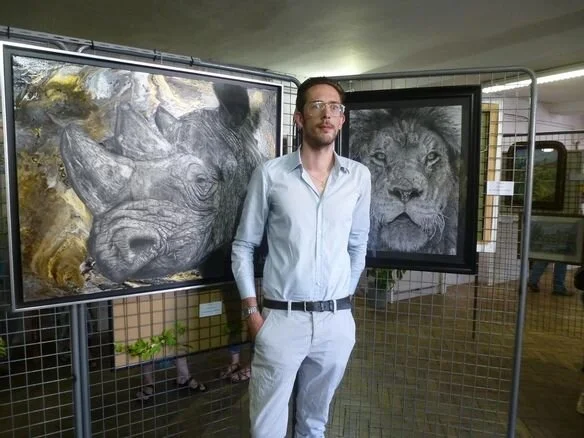
Through remarkably detailed black-and-white drawings, French artist Alexis Raoult captures the presence, sensitivity and individuality of the animal world.
Drawing has been a constant in Alexis Raoult's life. Born in the Paris region in 1993, he followed an unconventional path before dedicating himself fully to art. As a teenager, he studied electrical work while continuing to fill notebooks with drawings. At 18, he moved to Brittany, where he took on various jobs while continuing to sketch.
In 2012, drawing became the centre of his practice, a process he describes as a "sequence of emotions." After experimenting with portraits and painting, he gradually returned to drawing as the medium through which he could pursue an increasingly precise form of realism.
Capturing the Animal Gaze
Since 2017, animals have become central to Raoult's work. His monochrome portraits focus not simply on anatomical precision, but on expression. Through the gaze, posture and smallest details of his subjects, he seeks to convey the sensitivity and intelligence of wild animals.
Working primarily in black and white, Raoult builds his images through meticulous drawing, creating an intensity that gives his subjects an almost physical presence. Rather than treating the animal as an object of observation, his portraits invite the viewer into a direct encounter.

From Photography to Drawing
A decisive moment came through his encounter with photographer Lambert Davis. One of Davis's photographs, depicting a monkey with an especially intense gaze, inspired Raoult to translate the image into drawing. Their collaboration continued, and Raoult subsequently worked from photographs by other photographers.
Since 2020, however, another element has entered his process: Raoult has increasingly begun working from his own photographs, giving him greater control over the encounter that precedes the drawing itself.
Photography and drawing therefore become successive stages of the same observation: first meeting the subject through the lens, then returning to it slowly through the act of drawing.