RoamCouch: The Poetry of Stencil

Layer by layer, Japanese artist RoamCouch transforms the precision of stencil into images filled with memory, light and quiet emotion.

Behind the name RoamCouch is Ryo Ogawa, a Japanese artist whose work has pushed stencil far beyond its associations with repetition and immediacy. His images are intricate, atmospheric and often cinematic: cities glow at night, figures appear beneath vast skies, and flashes of colour interrupt otherwise monochrome landscapes.

At the heart of this visual language is an exceptionally meticulous process. Some of RoamCouch's works are built from more than fifty layers of hand-cut stencils, each adding another element of depth, shadow or detail. The technique is demanding, but precision is never the final purpose. What matters is the atmosphere that emerges from it.
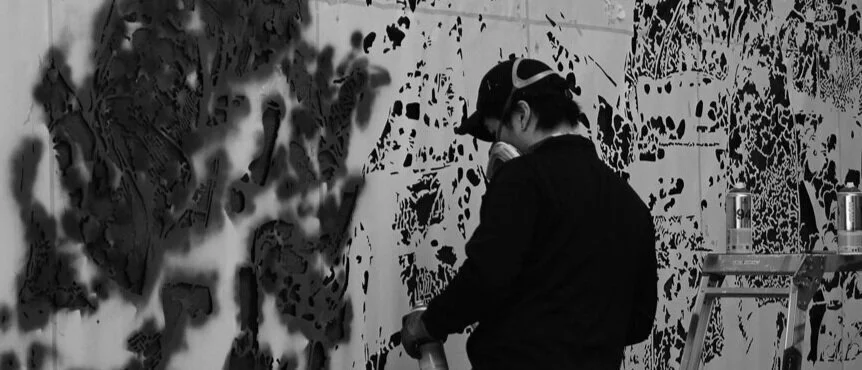
Japanese artist RoamCouch working on a large-scale stencil artwork

Between Precision and Emotion

Before becoming a full-time artist, Ogawa worked as a designer. After a serious illness led him to reconsider the direction of his life, he began his transition into art and adopted the name RoamCouch in 2011. His background in design remains visible in the careful construction of his compositions, but his works are driven just as much by emotion and storytelling.

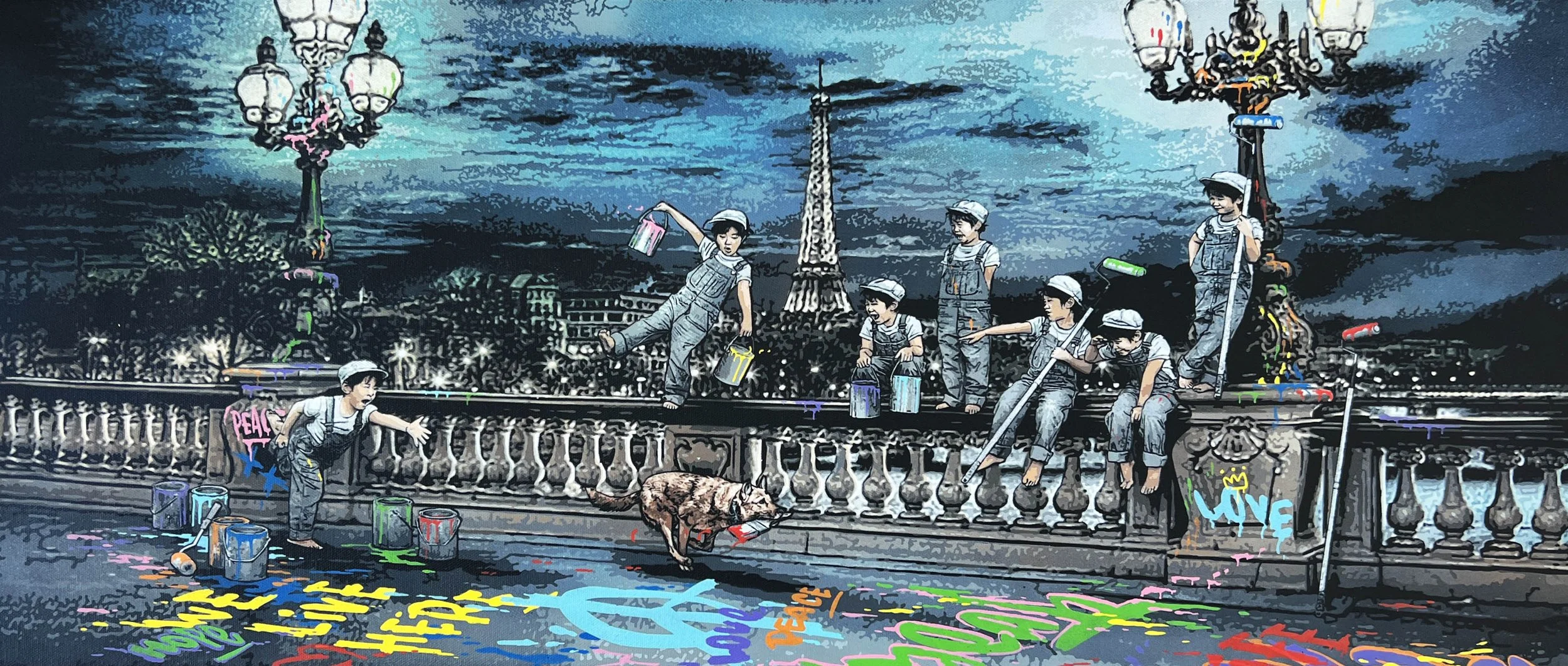
Recurring cityscapes become stages for intimate moments. Children run through streets, couples meet beneath stars, bridges stretch towards distant skylines. Familiar places such as Paris, London or New York are transformed into something closer to memory than documentation.

Colour often plays a decisive role. Against detailed monochrome backgrounds, sudden bands of rainbow colour, scattered light or painted interventions introduce movement and imagination. In works such as Rainbow Inc. Paris, the contrast transforms a recognisable view of the Eiffel Tower and the Seine into a scene suspended somewhere between reality and dream.
A Contemporary Dialogue with Japan

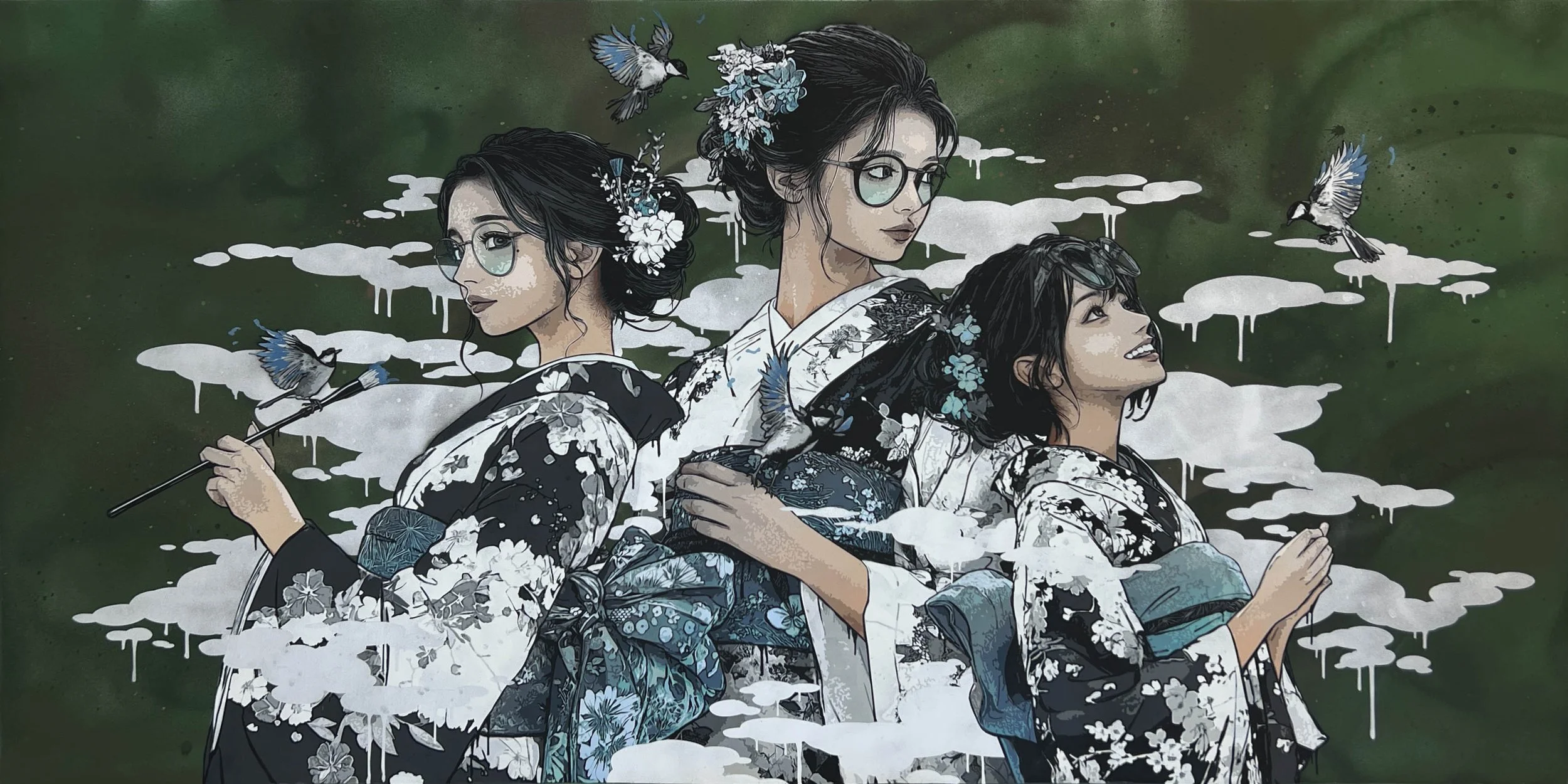
RoamCouch's practice also remains closely connected to Japanese visual culture. He describes part of his work as “Neo Ukiyo-e,” combining contemporary stencil techniques with Mino washi, the traditional Japanese paper associated with his home region of Gifu. Rather than reproducing ukiyo-e, he brings its visual heritage into conversation with contemporary imagery and street art.

That relationship with place extends beyond the studio. In 2014, RoamCouch launched the Emotional Bridge Project in Gifu, creating murals as a way of bringing art into the community and attracting visitors to his hometown. His international practice and his local roots have continued to develop alongside one another.
From Gifu to Paris

RoamCouch's relationship with NextStreet Gallery has unfolded over several years. His 2022 solo exhibition, Seeking the Stars, introduced Paris audiences to his dreamlike cityscapes and layered stencil technique. In September 2025, he returned to the gallery with Stencil Poet: Whispers of the Seasons, a solo exhibition that further explored the poetic and emotional dimensions of his practice.

Across these different bodies of work, one tension remains constant: extraordinary technical control alongside a sense of tenderness and escape. RoamCouch may construct his images one stencil at a time, but the finished works are less about technique than what remains after it: a place, a memory, a fleeting moment imagined again.
Sébastien Bayet: Inside the Artist’s Studio

In Sébastien Bayet's paintings, the studio is more than a setting. It is a portrait of the artist, told through objects, materials and the traces of making.

For Sébastien Bayet, the artist's studio is a subject in its own right. Works in progress, scattered objects, fragments of colour, the quiet disorder of creation: these are the things that reveal an artist's world.

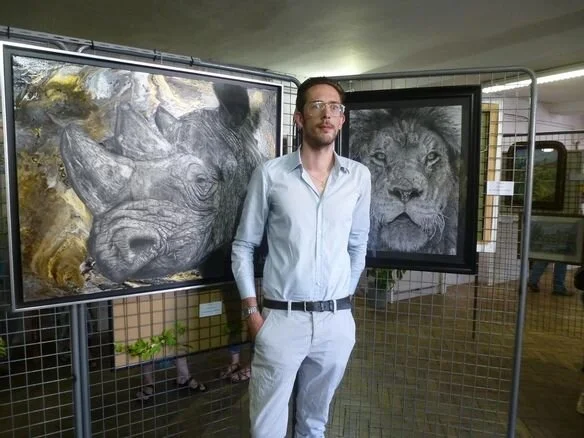
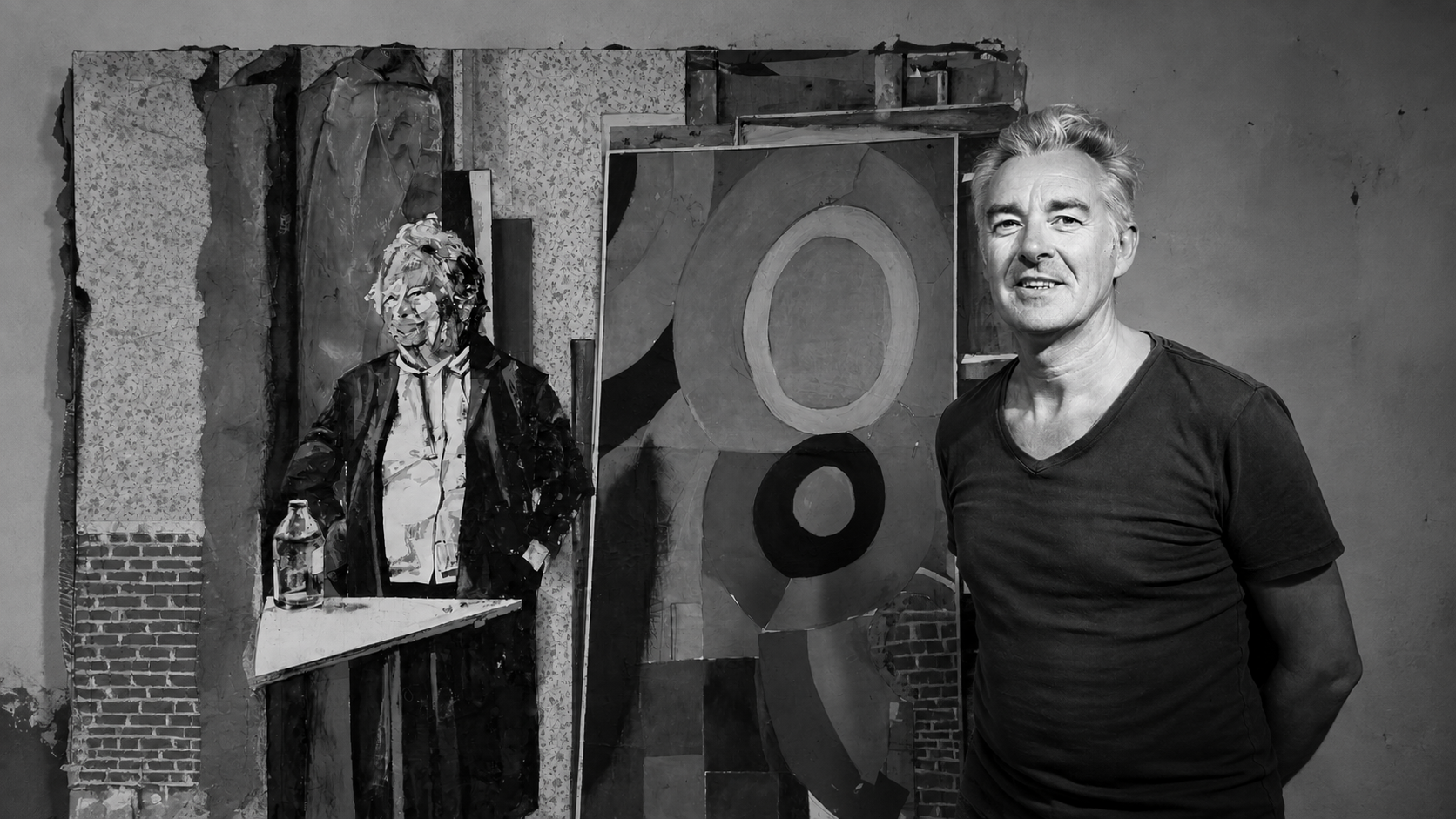
Sébastien Bayet in his studio with his artworks

In his recent series, Bayet revisits the studios of figures such as Sonia Delaunay, Frida Kahlo, Hilma af Klint, Nicolas de Staël, Tracey Emin and Rose Wylie. He does not reconstruct these interiors with documentary precision. Instead, he reimagines them in his own visual language, so that each studio becomes a portrait without relying on a face: a presence felt through the space someone inhabits and the work around them.

Material carries this idea further. Bayet moves between painting, collage and relief, combining oil paint with textiles, worn fabrics and found materials. Since 2017, his practice has included discarded sailcloth once used by Vezo fishermen in Madagascar, where he spends part of his time. Marked by use, weather and age, these fabrics arrive on the canvas with a history already embedded in their surfaces.

Sébastien Bayet artwork with close-up details of layered paint and textile collage

The result is a body of work that is felt as much as seen. Fabrics overlap, edges stay visible, and painted passages meet surfaces already altered by time. The image is built in layers, and so is its sense of memory.

In works such as Après l'atelier – Sonia Delaunay, portraiture, geometric forms and textile fragments share a single composition. The studio becomes both a real place and an imagined one, where Bayet's own materials meet the artistic histories he chooses to revisit.

At NextStreet Gallery, these works reward a slower look. Seams, frayed edges and traces of wear are part of how the paintings are read, revealing details that only come into focus up close.

For Bayet, the studio is ultimately a place of traces: of gestures, objects, influences and time. Material becomes memory made visible.

Alexis Raoult: The Art of the Animal Portrait

Through remarkably detailed black-and-white drawings, French artist Alexis Raoult captures the presence, sensitivity and individuality of the animal world.

Drawing has been a constant in Alexis Raoult's life. Born in the Paris region in 1993, he followed an unconventional path before dedicating himself fully to art. As a teenager, he studied electrical work while continuing to fill notebooks with drawings. At 18, he moved to Brittany, where he took on various jobs while continuing to sketch.

In 2012, drawing became the centre of his practice, a process he describes as a "sequence of emotions." After experimenting with portraits and painting, he gradually returned to drawing as the medium through which he could pursue an increasingly precise form of realism.

Capturing the Animal Gaze

Since 2017, animals have become central to Raoult's work. His monochrome portraits focus not simply on anatomical precision, but on expression. Through the gaze, posture and smallest details of his subjects, he seeks to convey the sensitivity and intelligence of wild animals.

Working primarily in black and white, Raoult builds his images through meticulous drawing, creating an intensity that gives his subjects an almost physical presence. Rather than treating the animal as an object of observation, his portraits invite the viewer into a direct encounter.

From Photography to Drawing

A decisive moment came through his encounter with photographer Lambert Davis. One of Davis's photographs, depicting a monkey with an especially intense gaze, inspired Raoult to translate the image into drawing. Their collaboration continued, and Raoult subsequently worked from photographs by other photographers.

Since 2020, however, another element has entered his process: Raoult has increasingly begun working from his own photographs, giving him greater control over the encounter that precedes the drawing itself.

Photography and drawing therefore become successive stages of the same observation: first meeting the subject through the lens, then returning to it slowly through the act of drawing.