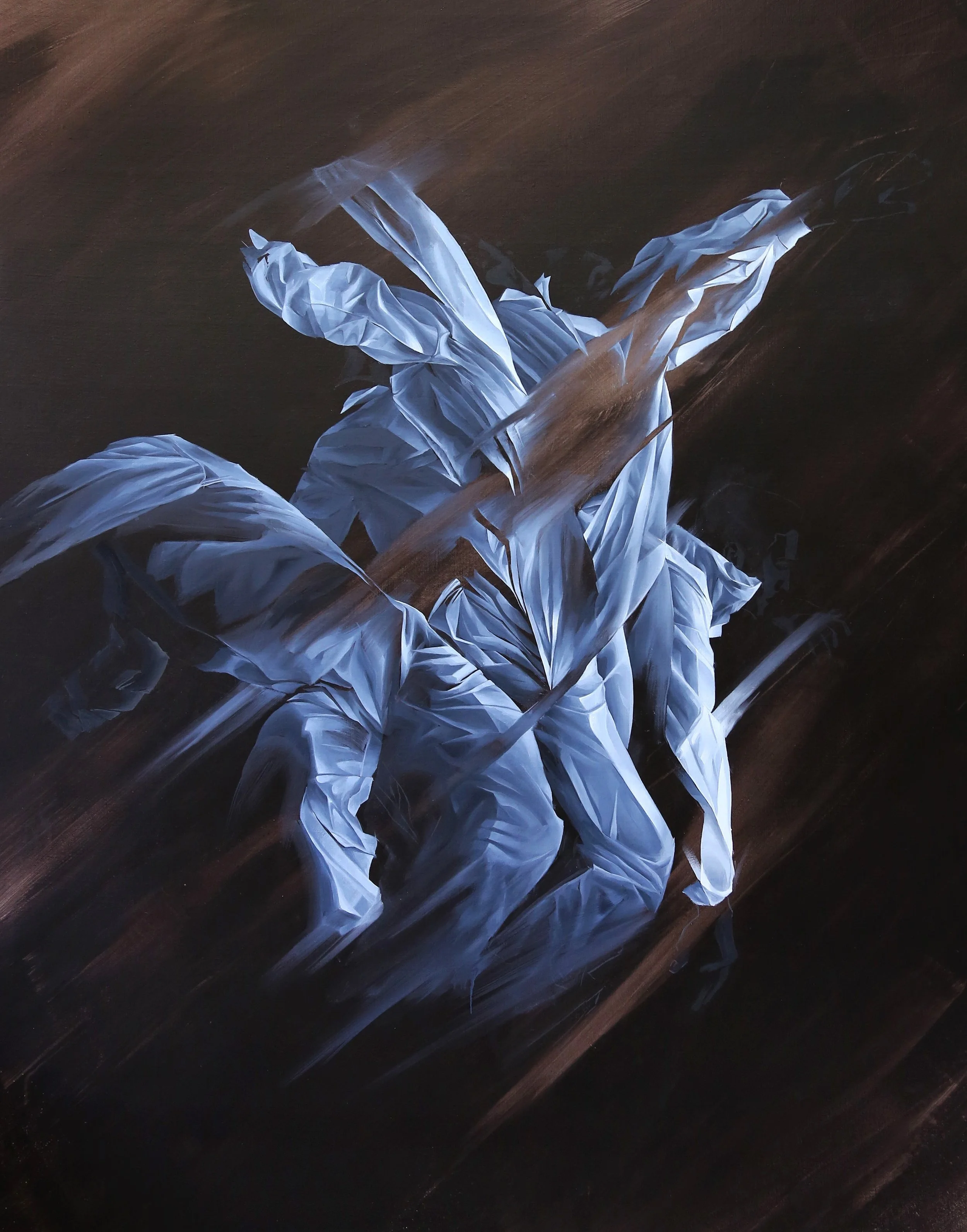
RoamCouch: The Poetry of Stencil

Layer by layer, Japanese artist RoamCouch transforms the precision of stencil into images filled with memory, light and quiet emotion.

Behind the name RoamCouch is Ryo Ogawa, a Japanese artist whose work has pushed stencil far beyond its associations with repetition and immediacy. His images are intricate, atmospheric and often cinematic: cities glow at night, figures appear beneath vast skies, and flashes of colour interrupt otherwise monochrome landscapes.

At the heart of this visual language is an exceptionally meticulous process. Some of RoamCouch's works are built from more than fifty layers of hand-cut stencils, each adding another element of depth, shadow or detail. The technique is demanding, but precision is never the final purpose. What matters is the atmosphere that emerges from it.
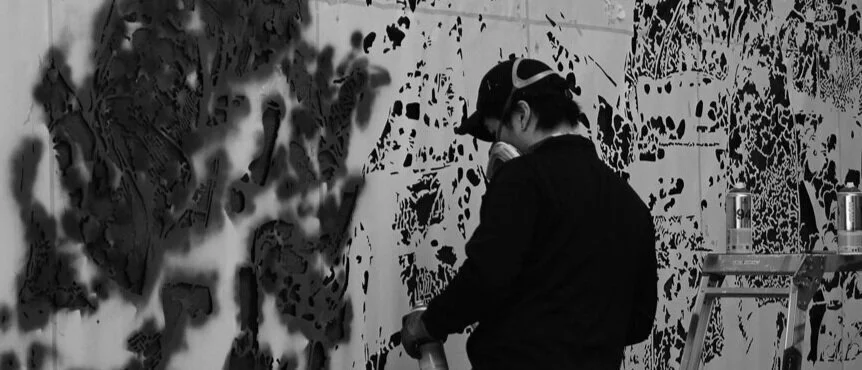
Japanese artist RoamCouch working on a large-scale stencil artwork

Between Precision and Emotion

Before becoming a full-time artist, Ogawa worked as a designer. After a serious illness led him to reconsider the direction of his life, he began his transition into art and adopted the name RoamCouch in 2011. His background in design remains visible in the careful construction of his compositions, but his works are driven just as much by emotion and storytelling.

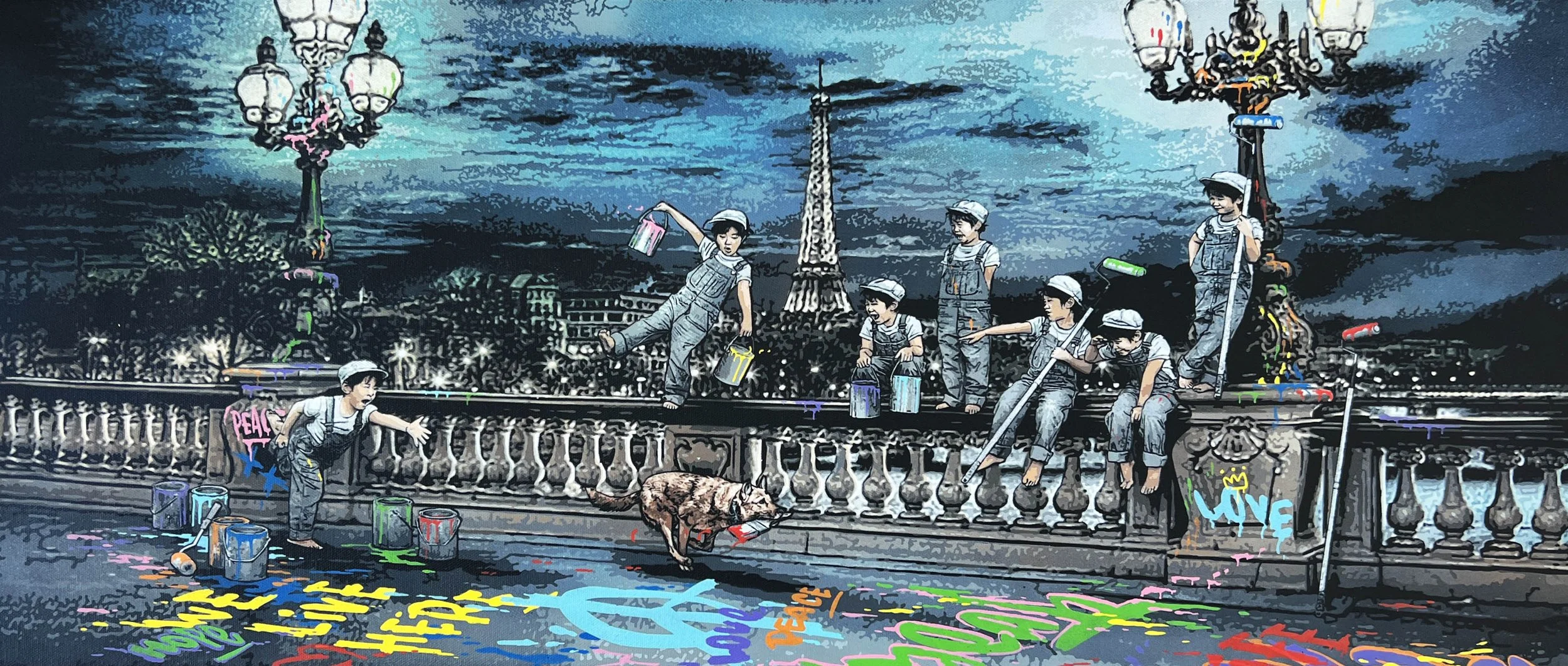
Recurring cityscapes become stages for intimate moments. Children run through streets, couples meet beneath stars, bridges stretch towards distant skylines. Familiar places such as Paris, London or New York are transformed into something closer to memory than documentation.

Colour often plays a decisive role. Against detailed monochrome backgrounds, sudden bands of rainbow colour, scattered light or painted interventions introduce movement and imagination. In works such as Rainbow Inc. Paris, the contrast transforms a recognisable view of the Eiffel Tower and the Seine into a scene suspended somewhere between reality and dream.
A Contemporary Dialogue with Japan

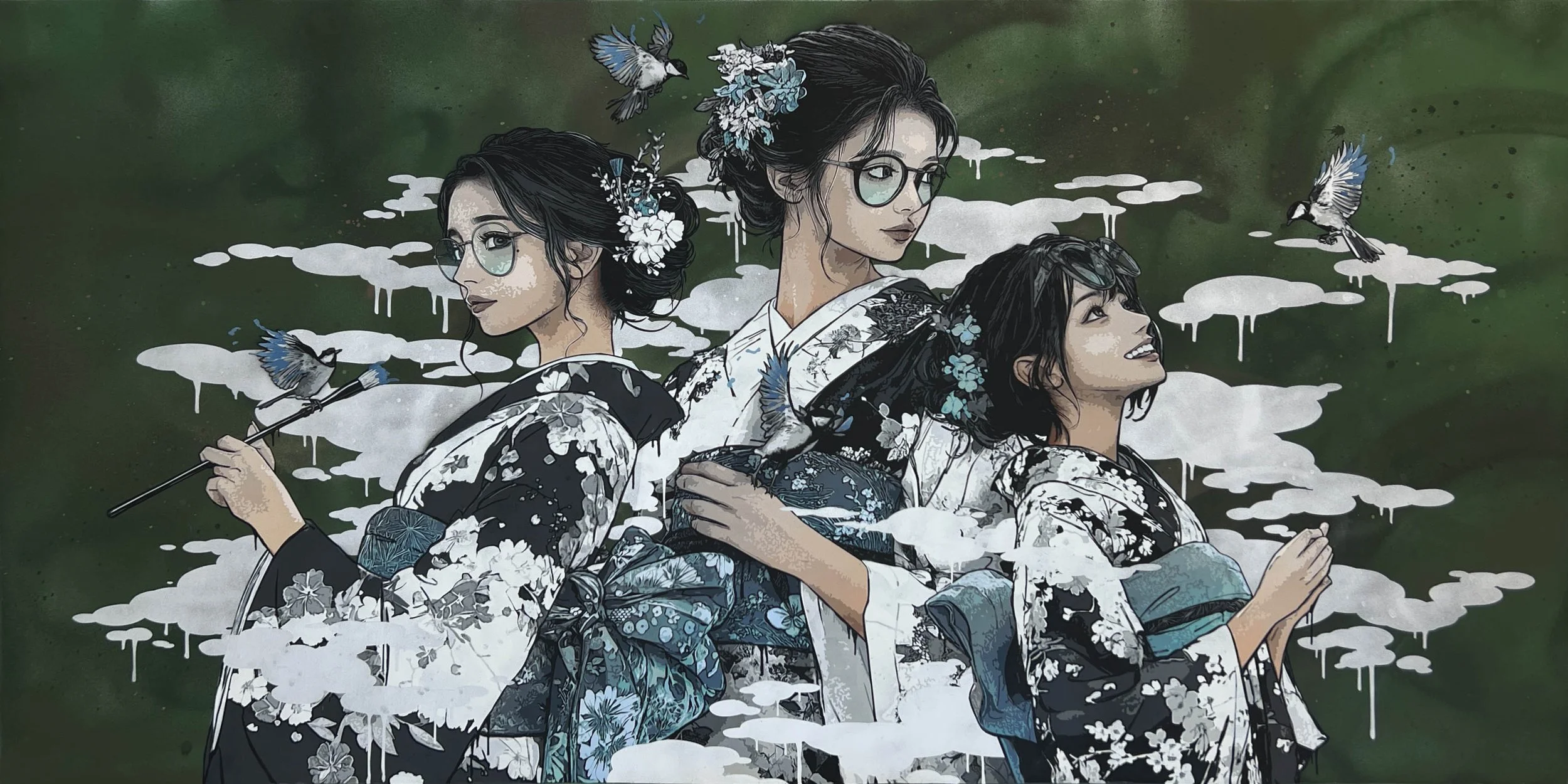
RoamCouch's practice also remains closely connected to Japanese visual culture. He describes part of his work as “Neo Ukiyo-e,” combining contemporary stencil techniques with Mino washi, the traditional Japanese paper associated with his home region of Gifu. Rather than reproducing ukiyo-e, he brings its visual heritage into conversation with contemporary imagery and street art.

That relationship with place extends beyond the studio. In 2014, RoamCouch launched the Emotional Bridge Project in Gifu, creating murals as a way of bringing art into the community and attracting visitors to his hometown. His international practice and his local roots have continued to develop alongside one another.
From Gifu to Paris

RoamCouch's relationship with NextStreet Gallery has unfolded over several years. His 2022 solo exhibition, Seeking the Stars, introduced Paris audiences to his dreamlike cityscapes and layered stencil technique. In September 2025, he returned to the gallery with Stencil Poet: Whispers of the Seasons, a solo exhibition that further explored the poetic and emotional dimensions of his practice.

Across these different bodies of work, one tension remains constant: extraordinary technical control alongside a sense of tenderness and escape. RoamCouch may construct his images one stencil at a time, but the finished works are less about technique than what remains after it: a place, a memory, a fleeting moment imagined again.
SAKE STC: Atlas at Danone's Convergence Headquarters

For Danone's Convergence headquarters in Rueil-Malmaison, SAKE STC brought urban art into the heart of the architectural project with a monumental three-metre sculpture.

In 2021, NextStreet Gallery collaborated with French artist SAKE STC on an artistic project for Convergence, Danone's headquarters in Rueil-Malmaison, just outside Paris.

At the centre of the project stands Atlas, a three-metre-high sculpture created in resin, fiberglass and stainless steel. Installed in the building's central outdoor space, the work brings SAKE STC's distinctive visual language into dialogue with the contemporary architecture surrounding it.

Atlas is part of the artist's Statue Art Crime project, in which references to classical sculpture meet the codes and energy of graffiti and urban art. By bringing these different visual traditions together, SAKE STC transforms the monumental language of classical statuary through a contemporary street-art perspective.

Art at the Heart of Convergence

Designed by ORY.architecture, Convergence was completed in 2020 after more than two years of construction. The complex extends across approximately 25,000 square metres and was conceived around an open, landscaped central patio. At the time of its completion, it was presented as Danone's largest headquarters worldwide.

Art formed part of the project from the outset. Alongside Atlas, the development also incorporated interventions by local graffiti artists, bringing contemporary artistic practices into the everyday environment of the workplace.

For NextStreet Gallery, the project reflects a broader dialogue between urban art, sculpture and architecture, taking SAKE STC's work beyond the traditional exhibition space and placing it directly within a large-scale architectural setting.

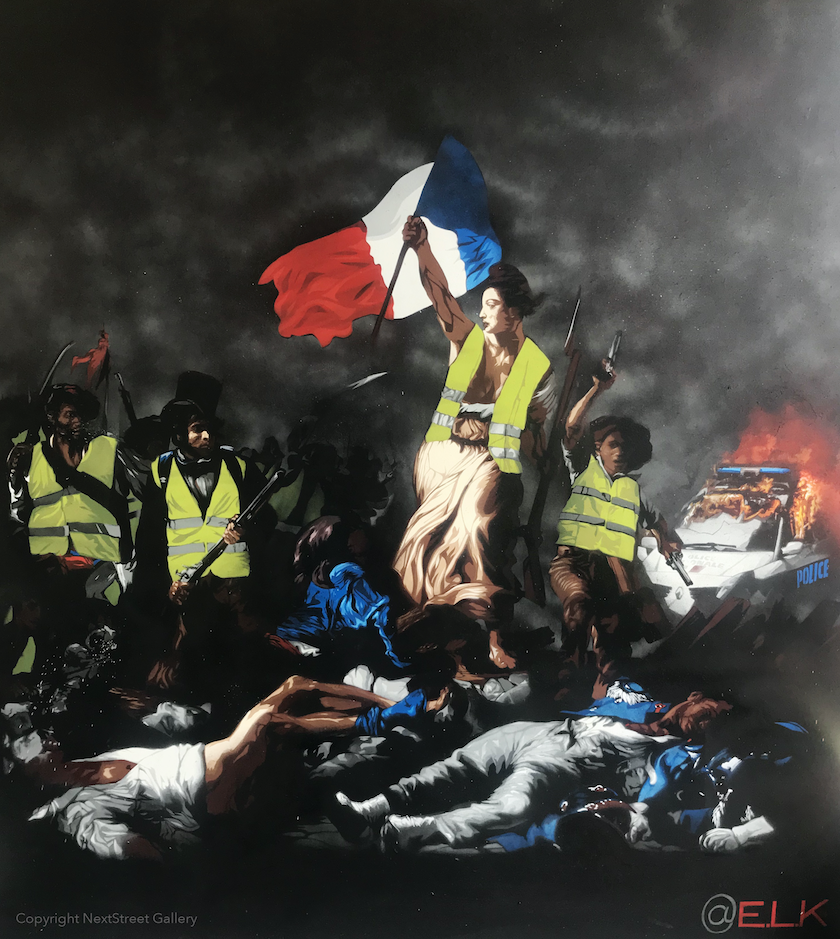
MURAL WORK " GILET JAUNE" BY LUKE CORNISH AKA ELK

The Right to Riot

 Renowned Australian artist Luke Cornish, who works under the alias ELK, joined NextStreet Art Gallery last night for a live demonstration of his mural work. Before the performance, we had the opportunity to sit down with him to better understand the intention behind his work. His piece, based on Delacroix’s La Liberté Guidant le Peuple (1830), captures his perception of the modern “French spirit”, particularly with reference to the Gilet Jaune movement. What started as a grassroots citizens protest against the fuel tax, has escalated to a wider anti-government sentiment.  As an outsider, ELK attempts to document what makes this movement pertinent on a global scale, and what it means to have the right to riot.

Screen Shot 2019-04-09 at 13.47.59.png

1789 remains one of the most politically, socially and artistically influential dates in the history of France. The tumultuous six years that followed the storming of the Bastille, involved a violent dismantling of the monarchy. The timeline of events that occurred during this period is eerily similar to the protests taking place in modern day Paris, albeit disguised with modern apparel and weaponry. The formulaic tradition of protesting see\ms to be a part of French culture; everyday citizens rising up to fight for better living conditions. However, the development of technology has enabled the acceleration of this trend throughout time. In our current global climate, the need for change is an epidemic reaching further than the streets of Paris. This is the quest for liberty that ELK is trying to capture with his work.


Cornish, originally from Canberra and working predominantly out of Sydney, takes his love for street art around the world. He has travelled to countries such as Syria and Lebanon to work with those faced with the crisis of liberty on a daily basis. Having experienced it himself, ELK was inspired to create a series about the human plight. He often says that being an artist is akin to being an investigator: someone who sheds light on what plagues society, and documents it in order to change the status quo. Upon arriving to Paris and witnessing the Gilet Jaune uprisings, ELK found similarities with other experiences around the world. He concluded that the notion of society’s inability to put up with injustice, is a cyclical entity.


His artwork utilizes classical imagery as a vehicle to parallel modern phenomena with the age-old struggle for justice. When comparing La Liberté Guidant Le Peuple to Cornish’s mural work, we see an evolved France; a diverse selection of protagonists representing todays bourgeois population. The bright yellow vests serve to highlight the desire for equal platform and opportunity. As he works, Tourists and Parisians pause outside NextStreet to ponder the implications of the piece. When something so violent and pertinent is placed on a canvas- it becomes a struggle of the mind more than one of the streets for a brief time. This is a fascinating dynamic that ELK works to uncover.


IMG_5564.jpg

When asked about his process, Cornish starts by clarifying that his job, as an artist, is to hold a mirror up to society. This is a solitary position to be in, but necessary by nature. It is one that requires patience, an open mind and somewhat of an obsessive need to understand and document. The result of this is evidently reflected in his thought-provoking work, that we are proud to host at NextStreet gallery. We are curious to see how the mural might start a further dialogue around what it means to have the right to riot, on a global scale.


FEATURE: AARON LI-HILL

Aaron Li-Hill is Canadian artist who is currently based out of Brooklyn. His incredibly diverse upbringing reflects his career. He has Australian, Polish, Canadian and Chinese origins, and was brought up in both downtown Toronto and California. His works vary dramatically by scale, medium and subject, which makes him a notable emerging artist in the world of street art. While pursuing a Bachelor of fine Arts from OCAD; one of the most comprehensive art, design and media universities in Canada, he found a passion for mural work and Graffiti. He has collaborated on international shows in Australia, Thailand, Mexico and China. 

“Suspended”

“Suspended”

One of the most fascinating parts of Li-Hill’s work are his multi-faceted subjects who guide the audience’s eye towards something greater and external. The dynamic movement creates episodic scenes that are similar to a sequence of successively shot photographs, or a flip book. The result is the illusion of a single subject entangled in paradoxes that are both self-imposed and conditional. 

 His greatest inspiration has been the conflict between the individual and society. This evolving world demands constant reinvention of one’s self and environment. This has become a necessity of survival, but is growing at such a fast pace in a consumerist driven society, that the internal and external balances of the world are constantly being disrupted. This leaves us in a constant scramble to keep up- a sense that is clearly evoked in Li-Hill’s artwork. 

 His formal training in graphic design, illustration, painting and sculpture, as well has his informal fascination with literature, travel and film has shaped his artistic manifesto. He works with walls, multi-layered recycled materials as well as conventional canvases. Through the manipulation of light and medium, he able to create distinctive pieces. NextStreet gallery is honored to have a working relationship with Li-Hill, and is proud to present several of his pieces which are currently on display. 


For price inquiries, please email contact@nextstreetgallery.com