
VICTOR VASARELY
ABOUT
Victor Vasarely (1906–1997) was a Hungarian-French artist and one of the leading figures of the Op Art movement. Through geometric abstraction and experiments with color and form, he developed a distinctive visual language exploring perception, movement and optical illusion.
Originally trained in medicine in Budapest, Vasarely later turned to art and moved to Paris in 1930. His interest in scientific thinking, structure and visual perception would become fundamental to his artistic practice.
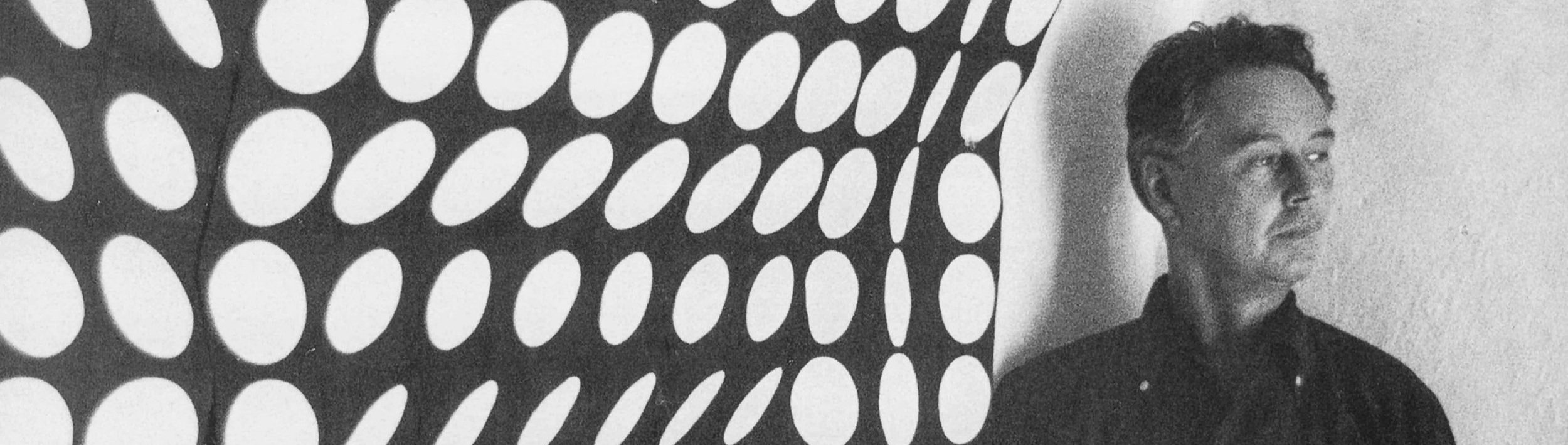
From the 1950s onward, Vasarely used repeated geometric forms, contrasting colors and calculated distortions to create sensations of depth, vibration and movement. His paintings, prints and sculptures played a central role in the development of Op Art and its international recognition during the 1960s.
Vasarely exhibited internationally throughout his career, and his work is held in major collections including the Museum of Modern Art in New York and the Centre Pompidou in Paris. His experiments with geometry, color and perception continue to influence contemporary art, design and visual culture.


